“The window is open. Ten years ago, the phrase “African AI” would have drawn puzzled looks in Silicon Valley.”
By Nana | For DUNIA Magazine

There is an Ethiopian proverb that says, “When spider webs unite, they can tie up a lion.” Across Africa today, millions of small threads are being woven together, and the lion they are tying up is a familiar one: distance, scarcity, and the old assumption that the newest technology always arrives on the continent last. This time, something different is happening. Artificial intelligence (AI) is not arriving in Africa. It is being built there.
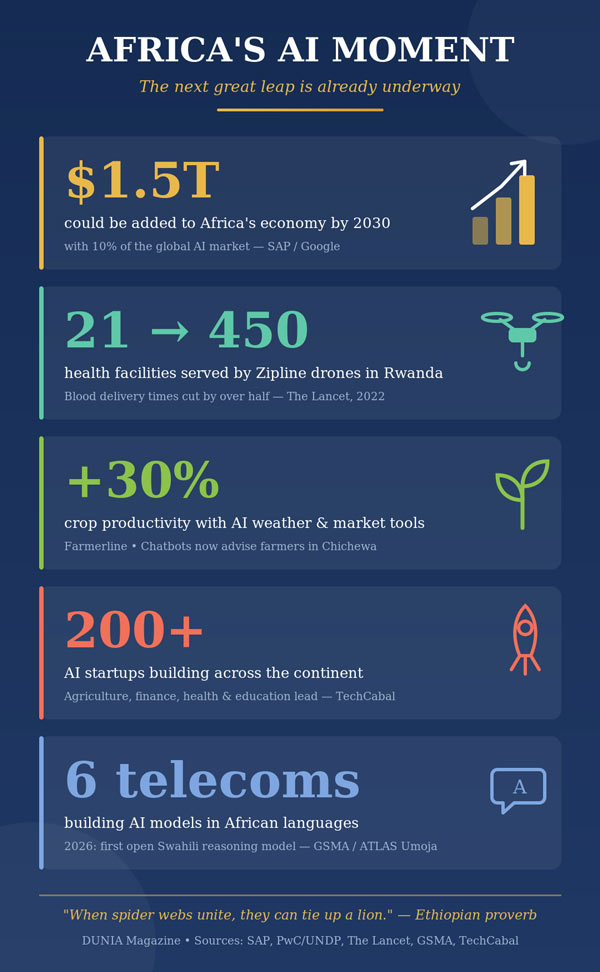
Consider a district hospital in rural Rwanda. A mother is hemorrhaging after childbirth, and the blood bank is hours away by road. A message goes out, and within minutes a small autonomous aircraft appears overhead and drops chilled blood by parachute into the hospital courtyard. This is not science fiction. It is an ordinary Tuesday for Zipline, the drone delivery network that launched in Rwanda in 2016 and has grown from serving 21 hospitals to roughly 450 health facilities. A 2022 study in The Lancet found the drones cut average blood delivery times by more than half compared to road transport. Rwanda has since become the first country in the world with nationwide drone health delivery, and Zipline is building its first overseas AI and robotics facility there.
A Trillion-Dollar Question
The numbers being attached to this moment are staggering. Analysts at PwC and the UN Development Programme estimate that AI could add around $1.2 trillion to African economies by 2030, while SAP and Google executives put the figure at $1.5 trillion if the continent captures even a tenth of the global AI market.
Numbers that large can feel abstract. What they describe, in human terms, is a doctor who sees more patients, a farmer who loses fewer harvests, a student who learns in her own language, and a young graduate who builds a company instead of waiting for a job.

Africa Has Leapfrogged Before
Skeptics will say the continent lacks the infrastructure for an AI revolution. They said the same thing about banking. Africa never waited to build a branch on every corner; instead, Kenya gave the world M-Pesa, and mobile money leapt over the entire brick-and-mortar era of finance. Today that same leapfrog logic is at work again. Companies like M-KOPA use AI credit scoring to extend loans to people no traditional bank would touch, and Kenya’s Apollo Agriculture offers farmers financing they repay from crop sales tracked entirely by phone. The lesson of mobile money was that Africa does not need to retrace the steps of other regions. It can skip them.
AI That Speaks Our Languages
Perhaps the most quietly radical development is in linguistics. For decades, the digital world spoke English, French, and Mandarin, and Africans adapted. Now the adaptation is running in the other direction.
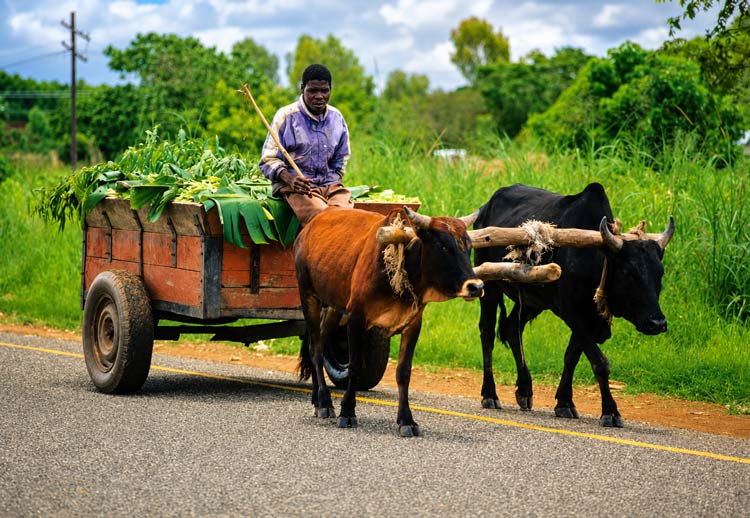
In Malawi, farmers ask a chatbot called Ulangizi for advice about crops and livestock in Chichewa, and it answers in Chichewa. In Ghana, GhAI Labs is building health chat models in Twi.
Six of the continent’s largest mobile operators, including MTN, Orange, Vodacom, Airtel, Ethio Telecom, and Axian, have joined forces to train AI models on African languages, and a pan-African initiative called ATLAS Umoja AI aims to do the same at continental scale. Earlier this year, developers demonstrated the first open Swahili reasoning model. When a technology learns to speak to a grandmother in her mother tongue, it stops being foreign. It becomes hers.
From Farm to Clinic to Classroom
The pattern repeats across sectors. Farmerline, working across East Africa, reports that farmers using its AI-driven weather and market tools have raised crop productivity by as much as 30 percent. In Nigeria, the startup Scandium, selected for Google’s 2026 accelerator, builds AI tools that catch software bugs for Lagos banks and hospitals. In Tanzania, the agritech firm NovFeed took the top prize at Africa’s Business Heroes for reinventing animal feed.
A recent industry census counted more than 200 AI startups on the continent, with agriculture, finance, healthcare, and education attracting the deepest investment. This focus matters: African founders are aiming AI at the problems their own communities feel most acutely.
What the Moment Demands
None of this is guaranteed. The promise comes with real work attached. Africa holds the world’s youngest population, and turning that into an advantage means investing seriously in AI skills, from coding academies in Kigali and Lagos to data science courses in Accra and Nairobi. It means governments writing thoughtful policy, so that African data creates African value rather than being exported raw like so many commodities before it. It means expanding electricity and connectivity so that a brilliant mind in a small town has the same tools as one in a capital city. And it means the diaspora, reading articles like this one from London, Houston, or Toronto, asking a simple question: what can I send home besides money? Skills, mentorship, and investment now travel as easily as remittances.
The window is open. Ten years ago, the phrase “African AI” would have drawn puzzled looks in Silicon Valley. Today, drones cross Rwandan skies, chatbots counsel farmers in Chichewa, and Swahili has a reasoning model of its own. The spider webs are uniting. The lion, this time, does not stand a chance.
***
Sharon is an experienced IT and defense contractor who writes with Alignexia Group Corp on AI governance, risk, and compliance (AI GRC), AI in Africa, and the future of intelligent operations. Connect with her on LinkedIn @Alignexia Group Corp and @Dunia Magazine. www.alignexia.com
——–
Sources
The Lancet (2022) via African Business: Zipline drone blood delivery times in Rwanda
TechAfrica News (Feb 2026): Rwanda first country with nationwide Zipline health drone delivery
SAP Africa / Ecofin Agency: AI projected to add $1.5 trillion to Africa’s economy by 2030
UNDP / PwC: AI could contribute about $1.2 trillion to African economies by 2030
TIME: Ulangizi chatbot serving farmers in Chichewa, Malawi
Techpoint Africa / GSMA: Six African mobile operators building African-language AI models
TechBooky: ATLAS Umoja AI pan-African language initiative; first open Swahili reasoning model
TechCabal Insights: census of 200+ African AI startups
Connecting Africa: Scandium, GhAI Labs, Apollo Agriculture, NovFeed