Singing Conflict into Peace: Women’s Political Agency, Satire, and Social Criticism in Aghem Ufueng Performance
By Kedze Marcevinus Akah
Abstract
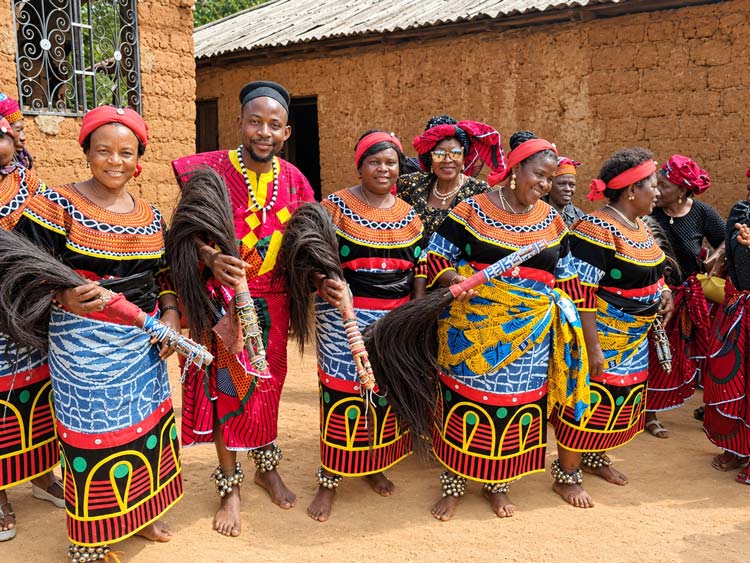
This paper examines how women use satire and social criticism in Ufueng performance to respond to conflict and promote peace in Aghem, in the North West Region of Cameroon. Ufueng, also known as Nyanga dance [beauty/stylish dance], is more than a form of cultural entertainment; it provides women with a public space to speak about problems affecting their families and community. The paper focuses on two Ufueng texts, “Farmer-grazier Problem” and “Social Criticism,” songs which address land conflict, political interests, violence, mourning, and the demands placed on women to perform during moments of communal suffering. Drawing on Feminist Peace Theory and Performance Theory, the study reads these songs as forms of political speech through which women expose social problems, question authority, express collective suffering, and call attention to the conditions that produce conflict. The analysis shows that satire and social criticism allow the performers to confront sensitive issues in a culturally recognized form while encouraging reflection on communal responsibility and peaceful coexistence. The paper argues that Ufueng expands the understanding of women’s peacebuilding beyond formal political institutions by showing how performance can become a space for criticism, negotiation, and political agency. It concludes that women’s Ufueng performances represent an important indigenous form of peacebuilding in which singing, mourning, satire, and social criticism become ways of speaking about conflict and imagining possibilities for peace.
Keywords: Ufueng, Satire, Agency, Peacebuilding, Performance
Introduction
Women’s songs and oral performances provide important spaces for expressing social experience and challenging power. Brian Hogan describes women’s verbal arts as a “crucial medium of political contestation, social unification, and personal expression” (1), showing how songs address inequality, authority, gender relations, and collective concerns, especially where women have limited access to formal political institutions. In Cameroon, Ivoline Kefen Budji’s study of the 2019 Women’s Lamentation March during the Anglophone Crisis similarly shows how women transformed culturally recognized mourning practices into nonviolent resistance and political communication, demonstrating that they can “consciously draw from these same norms to achieve their sociopolitical aims” (443). Hogan and Budji thus show that women’s political expression can occur through songs, lamentations, dances, rituals, and other culturally recognized performances that enable criticism, protest, negotiation, and collective grievance. This is relevant to peacebuilding, as Aili Mari Tripp notes that women, often excluded from formal peace processes, use informal strategies to address violence, land, resources, and community protection. This study extends these perspectives to Ufueng, the Nyanga dance performed by women in Aghem, Wum Central Subdivision, of Menchum Division, in the North West Region of Cameroon. Through song, movement, rhythm, satire, lamentation, and social criticism, Ufueng creates a culturally recognized space for women to address community concerns. Its peacebuilding significance lies not in portraying women as naturally peaceful, but in the political work they perform through tradition by exposing grievances, criticizing conduct, recalling violence, questioning authority, expressing communal suffering, and bringing social problems before the community.
The political and peacebuilding dimensions of Ufueng become particularly clear in the performance text identified in this study as “Farmer-grazier Problem.” The women address the Aghem community directly and connect land and cattle disputes with political interests and experiences of violence:
Oh Aghem people shall forever be quiet
This is our land and we only have to work with intelligence
Spoil it Aghem people, spoil it our cows
They say Aghem Fon has convened a community meeting
Njuh always love money,
Money, come and judge the land—
Njuh always love cows—
Cows come and judge the land
He also loves the Akus—
Akus all of you should come in number—
Your uncle says he wants to judge the happenings of the land.
The military that came here tortured us badly—
Since then, we have been, our bodies do not function well—
Strangers who came here raped our daughter to death—
We have been then till now, our bodies do not sound
Oh Aghem people shall forever be quiet
This is our land and we only have to work with intelligence
Spoil it Aghem people, spoil it our cows
The performance transforms conflict into public speech. Rather than merely describing the farmer-grazier problem, the women expose the interests, authorities, and experiences of violence surrounding it. Their repeated address to “Aghem people” makes the community both audience and target of criticism, while references to land, money, cattle, political authority, military torture, and sexual violence broaden the song into a critique of the conditions sustaining conflict. It thus reflects Hogan’s view of women’s oral expression as political contestation and extends Budji’s argument to another Northwestern Grassfields performance tradition.
The second performance examined in this article, “Social Criticism,” turns more directly to mourning, loss, and the expectations placed upon women during communal suffering:
Our father, who art in heaven—
Hello be thy name.
We beg this our power from God above who watches over us—
Because we have nobody.
They have taken their wives, kept them at home—
And come and taken us out,
That we should come and perform ‘Fembwe’ (women’s cult)
Did Kwifoy house ever ask that; whose child have they killed in the bush—
For them to perform Fembwe? We have suffered
Did Kwifoy house even ask that how many of us are left—
For them to perform Fembwe— we have suffered
Anybody who still have her corn leftover by cows—
Let the person be cooking fufu let dances eat,
Anybody who still have her children she is laughing with them at home—
Let them be performing,
We are mourning our children
Our father, who art in heaven—
Hello be thy name.
Here, Ufueng becomes a space where women question the relationship between cultural obligation and communal suffering. Although expected to perform, they use the performance to question whether those demanding it have considered their losses. The repeated question about children killed in the bush transforms mourning into social criticism, bringing prayer, lamentation, accusation, and performance together. Rather than withdrawing from the community, the women bring their suffering into public performance and make it part of the community’s moral and political conversation.
Although scholarship recognizes African women’s cultural performances as forms of political expression and has examined women’s protest in Cameroon, less attention has been given to how Ufueng, as a specifically Aghem women’s performance tradition, uses literary and performative devices to address conflict and peacebuilding. Budji focuses on women’s lamentation and political activism in the Northwestern Grassfields, while Hogan examines women’s songs more broadly in West Africa; none of them examines Ufueng in Aghem or its combination of satire, social criticism, lamentation, and communal address. This study therefore examines how Aghem women use Ufueng as political agency and peacebuilding, arguing that it is not merely dance or entertainment but a form of public discourse through which women expose conflict, criticize social and political behaviour, articulate suffering, and encourage communal reflection. Reading “Farmer-grazier Problem” and “Social Criticism” as performance texts, the study shows how peacebuilding can occur through culturally embedded criticism, mourning, and public speaking, enabling Aghem women to confront conflict and negotiate possibilities for peaceful social relations.
“Farmer-grazier Problem”: Satire, Conflict, and Political Agency
“Farmer-grazier Problem” presents Ufueng as a space where Aghem women publicly address conflicts affecting their community. Rather than treating the farmer-grazier conflict merely as a dispute between farmers and cattle owners, the performance connects land to political authority, money, cattle, military and sexual violence, and ordinary people’s suffering. Through direct address, repetition, irony, accusation, and lamentation, the women turn the song into public criticism. Its political character lies not in formal government participation but in confronting the distribution and misuse of power within the community. As Brian Hogan observes, “the verbal arts are a crucial medium of political contestation, social unification, and personal expression” for many West African women (1). In this sense, “Farmer-grazier Problem” uses singing to bring land, power, and communal authority into public discussion.
The opening lines immediately establish the collective nature of the address:
Oh Aghem people shall forever be quiet
This is our land and we only have to work with intelligence
Spoil it Aghem people, spoil it our cows
The repeated address to “Aghem people” places performers and audience within the same community, while “shall forever be quiet” creates irony: the women speak while describing a community that remains silent, thereby breaking the very silence they identify. They position themselves as voices for a community facing a serious problem. “This is our land” links land to communal ownership, identity, livelihood, and survival rather than merely to economic value. The repeated “Spoil it Aghem people, spoil it our cows” adds sarcasm; the apparent instruction to “spoil” the land functions as a warning against its destruction. Through exaggeration and irony, the women expose the consequences of irresponsible treatment of communal resources, showing that satire is not merely entertaining but a culturally recognizable form of serious social criticism.
The song then turns directly towards the question of political decision-making:
They say Aghem Fon has convened a community meeting
Njuh always love money,
Money, come and judge the land-
Njuh always love cows-
Cows come and judge the land
He also loves the Akus-
Akus all of you should come in number-
Your uncle says he wants to judge the happenings of the land.
The song demonstrates how satire becomes a language of political accountability. By bringing the Fon, “money,” “cows,” and “Akus” into the discussion of land, the performers question the interests influencing its judgment. The rhetorical command that “Money” and “Cows” should come and “judge the land” turns competing interests into imagined political participants, raising the question: who or what is really determining the fate of the land? Through humour and satire, Ufueng questions whether communal decisions serve Aghem people or are shaped by wealth, cattle interests, or particular groups, making the performance a culturally sanctioned challenge to authority.
The performance becomes more serious as it moves from land and political interests to violence:
The military that came here tortured us badly-
Since then, we have been, our bodies do not function well-
Strangers who came here raped our daughter to death-
We have been then till now, our bodies doesn’t sound
Satire gives way to lamentation, linking the farmer-grazier conflict to wider experiences of violence. “Our bodies do not function well” shows the enduring effects of torture, while the rape and death of “our daughter” turn sexual violence into a communal wound. The collective “we” transforms individual pain into shared testimony, allowing Ufueng to publicly voice otherwise private suffering and thereby function as a peacebuilding practice. As Budji argues, women can “consciously draw from these same norms to achieve their sociopolitical aims” (443); thus, culturally recognized lamentation can make violence visible and demand recognition. “Our daughter”also gives the performance a gendered dimension, connecting the female body, family, land, and political authority and challenging the separation of women’s private suffering from the public politics of conflict.
“Social Criticism”: Mourning, Gendered Suffering, and Social Mediation
While “Farmer-grazier Problem” focuses strongly on land, political interests, and physical violence, “Social Criticism” turns attention to women’s own experience of communal suffering. The performance is particularly significant because it places mourning and cultural performance in tension. The women are expected to perform, yet they are themselves affected by the violence that has damaged the community. The song therefore questions the assumption that cultural obligations can continue normally when members of the community are grieving. Through prayer, irony, rhetorical questions, and lamentation, the performers make their suffering part of the public conversation.
The performance opens by adapting the familiar Christian prayer:
Our father, who art in heaven-
Hello be thy name.
We beg this our power from God above who watches over us-
Because we have nobody.
The opening immediately establishes a tone different from the direct satire of “Farmer-grazier Problem.” The invocation of God suggests helplessness and the search for protection beyond human authority. The statement “Because we have nobody” is especially important. It expresses a sense of abandonment and exposes the vulnerability of women who feel that the institutions or individuals expected to protect them have failed to do so. Prayer consequently becomes more than religious language. Within the performance, it becomes a vehicle for expressing a political and social grievance.
The next lines introduce the problem of performance itself:
They have taken their wives, kept them at home –
And come and taken us out,
That we should come and perform ‘Fembwe’ (women’s cult).
The contrast between “their wives” and “us” is central to the gender politics of the song. The women suggest that those making demands upon them are protected from the conditions under which the women themselves must perform. The women have been brought out to perform ‘Fembwe’ while others remain at home. The performance thus exposes an unequal distribution of cultural responsibility. Women are expected to maintain communal cultural practices even when they are experiencing the consequences of conflict.
This contradiction becomes sharper through the rhetorical questions that follow:
Did Kwifoy house ever ask that; whose child have they killed in the bush-
For them to perform Fembwe? We have suffered
Did Kwifoy house even ask that how many of us are left-
For them to perform Fembwe- we have suffered
The repeated questions function as accusations. The performers ask whether those demanding the performance have considered the number of children killed or the number of women who remain. The repetition of “Did Kwifoy house” emphasizes the absence of recognition. The women are not simply saying that they are tired of performing; they are questioning whether the social authorities demanding their participation have acknowledged the human cost of the conflict. This is where social criticism becomes political. The women use the performance to question the priorities of those exercising authority. The repeated phrase “For them to perform Fembwe” exposes a contradiction between cultural expectation and lived suffering. A community may desire the continuation of its cultural practices, but the performers ask whether culture can be separated from the conditions in which people live. Their questions force the audience to consider whether cultural continuity should require women to suppress their grief.
The song’s rhetorical structure replaces formal argument with questions that draw the audience into moral evaluation. This reflects Hogan’s view of women’s verbal arts as spaces of “political contestation” (1), achieved in Ufueng through questioning social expectations and authority. The repeated “we have suffered” functions as both testimony and accusation, transforming individual losses into collective experience. Its rhythm makes suffering memorable and insists that it remain part of the community’s conversation.
The song then introduces a striking contrast between those who still possess the possibility of celebration and those who are mourning:
Anybody who still has her corn leftover by cows-
Let the person be cooking fufu let dances eat,
Anybody who still has her children she is laughing with them at home-
Let them be performing,
We are mourning our children
Corn destroyed or consumed by cows links the song to the farmer-grazier conflict, but the performers extend agricultural loss to the loss of children, showing that conflict damages both livelihoods and human relationships. The contrast between those who “be performing” and “we” who mourn reveals unequal experiences of violence. “Anybody who still has her children she is laughing with them at home” shows that celebration depends on survival, challenging the assumption that cultural obligations are experienced equally. Like Budji’s study of women’s lamentation during the Anglophone Crisis, “Social Criticism” turns mourning into public sociopolitical communication, using culturally established practices to voice loss and demand recognition (443). Its return to “Our father, who art in heaven— / Hello be thy name” creates a circular structure, framing the women’s criticism and mourning within a search for protection and justice. The performance thus expands women’s political agency beyond direct confrontation: by refusing to hide grief behind cultural expectations, women assert authority over how their suffering is understood. It also shows that peacebuilding requires more than reconciliation; acknowledging grievances and losses is necessary for meaningful peace. Ufueng therefore becomes a form of social mediation, bringing women’s experiences into public discussion and prompting reflection on communal responsibility.
Discussion
Together, “Farmer-grazier Problem” and “Social Criticism” show Ufueng as a culturally recognized space through which women publicly address difficult community issues. While the former moves from land conflict and political interests to communal violence, the latter moves from women’s suffering to the cultural expectations placed upon them. Both make conflict visible, give it a public voice through collective performance, and invite reflection on communal responsibility. Peacebuilding therefore emerges through criticism, recognition, and social negotiation, not merely through calls for peace. The performances also demonstrate that women’s political participation need not occur through formal institutions. Ufueng enables Aghem women to criticize political interests, question authority, express anger, mourn, and challenge social expectations within a culturally recognized form. Satire and lamentation, though different, serve a common purpose: satire exposes wrongdoing through irony and ridicule, while lamentation exposes suffering through grief and testimony. Thus, “Farmer-grazier Problem” makes political interests visible, while “Social Criticism” makes suffering impossible to ignore.
Conclusion
This study has examined Ufueng as a form of women’s political agency and peacebuilding in Aghem through “Farmer-grazier Problem” and “Social Criticism.” The performances show how land disputes, political interests, violence, loss, mourning, and cultural expectations become subjects of public discussion through song. “Farmer-grazier Problem” demonstrates the political force of satire and social criticism, as women question interests surrounding land, challenge authority, and expose violence. “Social Criticism” demonstrates the political significance of mourning, as women question the expectation to perform despite losing children and relatives, transforming grief into public criticism and a demand for recognition. Together, the performances show that peacebuilding can begin with naming conflict, articulating grievances, questioning authority, and negotiating communal responsibility, rather than with reconciliation alone. Ufueng therefore expands understandings of women’s peacebuilding by showing that formal political positions are not necessary for cultural practices to become politically significant. As Hogan identifies women’s verbal arts as a medium of political contestation (1), and Budji demonstrates the sociopolitical potential of culturally grounded women’s performances in Cameroon (443), Ufueng emerges as both an artistic tradition and an indigenous peace-oriented political practice through which Aghem women make conflict visible and place communal responsibility before their audience.
Read the Full Paper
APPENDIX I: Transcribed Ufueng Texts in Aghem
“Social Criticism,” : Zənlònaʼesɛ̀
Ŋ̀ Ghə̂m ghò a, Ghə̂m ghò a. · A lo ezuw ko mɔŋ. · Wo zən lò naʼ e sɛ̀. · Sɛ ki ko alefwàʼ a lo kətuw. · bonlo a Ghə̂m ghò · bonlo a mbɔ̀ŋ taʼa to. · Wo ghe laʼa so də̀ŋ kə Aghə̀m kən so e saʼ kəbe. · Wo Ndzughu ləghaa tsə̀ghà ùkʉa · Kʉa wo, bùgho saʼ be ko. · Wo Ndzughu ləghaa tə̀mbɔ̀ŋ, wo mbɔ̀ŋ tò, kwən saʼ be ko. · Ù nyɔ̀ʼɔ̀ ləghaa Àkuw, Àkuw ghɛ̀ təŋo kwən wo a dzə̀m. · Numsə̂zùghù u mɔ̀ʼ mò dzɛ̀ nyəa e so e saʼ kəbe. · Gbele təlā tə fə nyə fɛ̄, ghe m bu boon ghàʼ ma. · Ghàʼ fɛ lò tsəgha êzə̄ŋ, tuw waʼa u fɛ fwàʼà yò. · Tûu təla tə fə nyə fɛ̄, ghe n nùŋ wī ghaʼ â wɛ̀ ma. · Ghàʼ fɛ lò tsəgha êzə̄ŋ mò ghue zaʼa e fɛ laan yō. · Ghə̂m ghò, Ghə̂m ghò, Ghəm ghò, a lo e zuuw ko mɔŋ. · Oo zən lò naʼ e sɛ̀, sɛ̀ ki ko alefwàʼ alo kətūw. · bonlo a Ghə̂m ghò, bonlo a mbɔ̀ŋ taʼa to a.̀ · Hù wo ghe laʼa so də̀ŋ kə Aghə̀m kən so e saʼ kəbe. · Wo Ndzughu ləghaa tsə̀ghà ùkʉa, kʉa wo, bùgho saʼ be ko. · Wo Ndzughu ləghaa tə̀mbɔ̀ŋ, wo mbɔ̀ŋ tò, kwən saʼ be ko. · Ù nyɔ̀ʼɔ̀ ləghaa sùghò, Àkuw. Wo Àkuw, ghɛ̀ təŋo kwən wo a dzə̀m. · Numsə̂zùghù u mɔ̀ʼ mò dzɛ̀ nyəa e so e saʼ kəbe. · Gbele təlā tə fə nyə fɛ̄, ghe m bu boon ghàʼ ma. · Ghàʼ fɛ lò tsəgha êzə̄ŋ, mo tuw waʼa u fɛ fwàʼà yò. · Tûu təla tə fə nyə fɛ̄, ghe n nùŋ wī ghaʼ â wɛ̀ ma. · Ghàʼ fɛ lò tsəgha êzə̄ŋ mò ghue zaʼa e fɛ laan yō. · Ghə̂m ghò, Ghə̂m ghò, Ghəm ghò, a lo e zuuw ko mɔŋ. · Wo zən lò naʼ e sɛ̀, sɛ̀ ki ko alefwàʼ alo kətūw. · bonlo a Ghə̂m ghò, bonlo a mbɔ̀ŋ taʼa to a.̀ ·
“Farmer-grazier Problem”: Ghà’nɔɔkəda’a
· Ghàʼ dwaʻa wən nɔɔ kɔʻɔ ndùw ko â Zə̀ kaʼa kəlā kə lɛɛ̄n ghaʼ māa. · Nu ghàʼ ki yo ghùw. · Ndòʼ nì kɔ̀ʼ yí á ghēe, · naŋa tàʼà tsūghū alo təndūghū bùghò sè sə̄ wò ghàʼ · Nyəa a bughò sə nzəgha. · Ndùghùkwîfɔ̀e ma fə bvʉ tsughu enyəa ghe wi wɛ ù ndùghò aŋ ɳgwən a ghɛ̀ səā zʉgha wō ā? · Ghàʼ ŋge fala nù. · Ndùghùkwîfɔ̀e ma fə bvʉ tsughu enyəa ghɛ̀ bûʼ dòʼòdòʼò a sòʼ ghɛ̀ səā zʉgha wō ā? · Ghàʼ tso ki yo ghùw. · Ghùw wə̀là ù kí sum u wə̄n wo mbɔ̀ŋ to mà pfʉ sə na tò ù lo e nāa nduw gbɛ wō zə̀ghà mò è zəa nduw. · Ghùw wə̀là ù kí wɛ a wən gho, ù tsoʼō ghèe ghee an ndughu, ù lo e səa nduw zə̀ghà mò. · Ghàʼ fɛ dìnlò àwɛ. · Ghàʻ dwaʼa wən nɔɔ kɔʼɔ ndùw ko â Zə̀ kaʼa kəlā kə lɛɛ̄n ghaʼ māa. · Nu ghàʼ ki yo ghùw. · Ndòʼ nì kɔ̀ʼ yí á ghēe, naŋa tàʼà tsūghū alo təndūghū bùghò sè sə̄ wò ghàʼ. · Nyəa a bughò sə nzəgha. · Ndùghùkwîfɔ̀e ma fə bvʉ tsughu enyəa ghe wi wɛ ù ndùghò aŋ ɳgwən a ghɛ̀ səā zʉgha wō ā? · Ghàʼ ŋge fala nù · Ndùghùkwîfɔ̀e ma fə bvʉ tsughu enyəa ghɛ̀ bûʼ dòʼòdòʼò a sòʼ ghɛ̀ səā zʉgha wō ā? · Ghàʼ tso ki yo ghùw. · Ghùw wə̀là ù kí sum u wə̄n wo mbɔ̀ŋ to mà pfʉ sə na tò ù lo e nāa nduw gbɛ wō zə̀ghà mò è zəa nduw. · Ghùw wə̀là ù kí wɛ a wən gho, ù tsoʼō ghèe ghee an ndughu, ù lo e səa nduw zə̀ghà mò. · Ghàʼ fɛ dìnlò àwɛ.
Works Cited
Budji, Ivoline Kefen. “Utilizing Sounds of Mourning as Protest and Activism: The 2019 Northwestern Women’s Lamentation March Within the Anglophone Crisis in Cameroon.” Resonance: The Journal of Sound and Culture, vol. 1, no. 4, 2020, pp. 443–461. University of California Press, https://doi.org/10.1525/res.2020.1.4.443.
Hogan, Brian. “Gendered Modes of Resistance: Power and Women’s Songs in West Africa.” Pacific Review of Ethnomusicology, vol. 13, 2008, Ethnomusicology Review, University of California, Los Angeles.
Schechner, Richard. Between Theater and Anthropology. University of Pennsylvania Press, 1985.
Tripp, Aili Mari. “Introduction: The Gendering of Peacebuilding in Africa.” Women and Peacebuilding in Africa, edited by Ladan Affi, Liv Tønnessen, and Aili Mari Tripp, Boydell & Brewer, 2021, pp. 1–28. https://doi.org/10.1017/9781800102705.001.
—
Paper was reviewed for DUNIA Magazine by Dr. Florence Mbi Nchia
***
Marcevinus Akah Kedze is a Cameroonian creative writer and author whose work engages with questions of gender, culture, identity, and postcolonial experience. He holds a B.A. in Literatures in English and an M.A. in Literatures and Digital Cultures from the University of Bamenda and is currently pursuing a High School Teacher Diploma at the Higher Teacher Training College, Bambili. His research interests include Gender Studies, Cultural Studies, Postcolonial Studies, and Feminism, with a particular interest in the ways literature and cultural expression illuminate social realities and human experiences.