Data centers are warehouse-sized facilities that house high-performance servers, networking hardware, and storage systems, that act as the physical backbone of the digital world. They power digital activities ranging from social media, online banking, cloud computing and artificial intelligence.

Every time a user streams a video, sends an email, processes a cloud document, or queries an artificial intelligence model, a data center not only processes that demand, it also stores that information in real time.
Why are data centers expanding at such a rapid rate
Data centers are currently expanding at an unprecedented rate as demand for digital services and artificial intelligence (AI) technology surges. Some factors driving this rapid increase include: the explosive rise of generative AI, widespread cloud migration, and the constant growth of global connectivity.
- As demand for digital services and AI technology climbs, companies are rapidly expanding data center infrastructure to process, store, and manage unprecedented amounts of information.
- Because AI applications require comparatively more computing power and energy than standard web browsing, tech companies are racing to construct massive new facilities to meet demand.
What environmental footprints do data centers leave
Rapid technological growth and the physical infrastructure required to sustain it carry a significant environmental footprint.
- Data centers operate round the clock consuming vast amounts of electricity, straining local power grids and driving up regional demand. To meet these energy needs, utility providers are building additional power plants, transmission lines, and supporting infrastructure—an expansion that can disrupt natural ecosystems, use up valuable land, and elevate energy costs.
- Depending on the energy sources used, data centers potentially contribute to greenhouse gas emissions. When electricity comes from fossil fuels such as coal and natural gas, generating the power needed to run these facilities releases carbon dioxide into the environment, contributing to climate change. Furthermore, reliance on on-site backup diesel generators and other such equipment releases toxic pollutants, threatening local air quality and public health.
- Additionally, thousands of gallons of water are routinely consumed daily in data centers to cool equipment, raising concerns over strain on local water resources and habitat disruption to meet increasing demand.
- Construction of these sprawling facilities can lead to loss of homes and alter historic rural landscapes.
- Changing land use and noise pollution due to the constant hum of equipment (cooling systems and backup generators) have led to escalating alarm over quality of life in the areas where data centers exist.
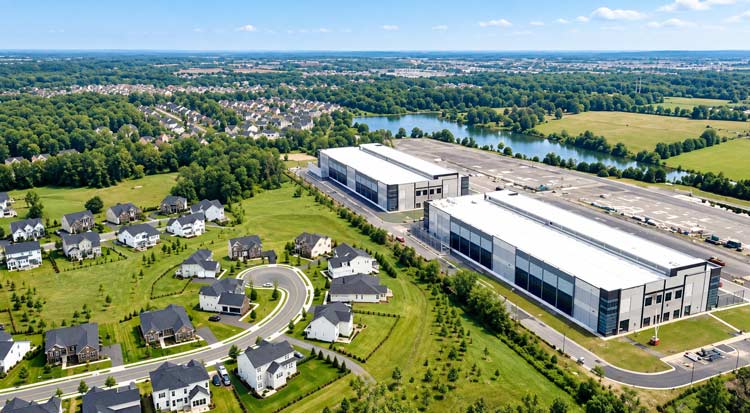
Areas of high concentration
Statistics on the global distribution of data centers show that the United States hosts by far the largest number, with 4,767 facilities, followed by the United Kingdom with 568, and Germany at 533.
Within the US, data centers are primarily concentrated in Northern Virginia, Dallas, Silicon Valley, Los Angeles, Chicago, Columbus, Phoenix, Atlanta, the New York Tri-State Area, and Portland-Oregon.
Data Center of the World
Nowhere is the growth of data centers more pronounced than in Northern Virginia, often dubbed “Data Center Alley” or ‘the Data Center of the World’.
Here vast land, dense fiber-optic networks, and favorable state tax incentives have concentrated world-leading digital infrastructure into areas like Loudoun and Prince William counties, leaving nearby communities grappling with the immediate human impacts of this industrial boom.
Rocanews took a deeper look at the data center explosion in the mid-Atlantic region of the US, examining what is driving growth, the social costs, and what could lie in the future of the communities hosting these facilities.
WATCH ‘INSIDE VIRGINIA’S DATA CENTER SUBURBS’
Ultimately, the convenience of our digital world comes with significant environmental and public burdens.
As data center development continues to expand, community leaders should carefully weigh the economic and technological benefits against potential consequences for local residents and the environment. Raising awareness about these impacts is essential to ensuring that technological progress does not come at the expense of community well-being and environmental sustainability.