From anti-hail nets and early-warning systems to climate insurance, Tunisia’s apple heartland needs a new model of agricultural risk management
By Dr. Sonia Toumia
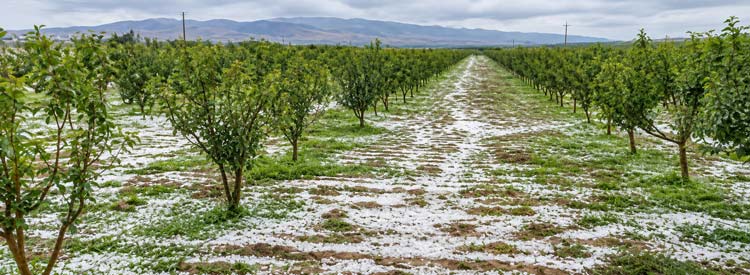
Hail does not fall only on apples.
When a violent hailstorm crosses an orchard in Kasserine, it can destroy within minutes the economic return of an entire agricultural year.
Behind every damaged fruit are months of labour, irrigation, pruning, fertilisation, farm investment and seasonal employment. Beyond the farm gate, the shock can spread to transporters, packhouses, cold-storage facilities, traders, processors and local communities.
That is why hail in Kasserine should no longer be treated simply as a meteorological event.
It is an economic risk.
The urgency is particularly clear in 2026. According to Tunisia’s agricultural authorities, apple production in Kasserine is expected to reach around 75,000 tonnes this season, compared with 62,000 tonnes the previous year — an increase of more than 20%. Production is concentrated particularly around the major apple-growing areas of Sbiba and Foussana.
The more valuable the harvest becomes, the greater the value that must be protected.
The real question is therefore no longer simply: What should farmers do after a hailstorm?
It is:
How can Kasserine prevent a successful apple season from becoming an economic crisis within a matter of minutes?
More than a crop: an entire territorial economy
In Kasserine, apples are far more than a seasonal agricultural commodity.
They support farmers, seasonal workers, irrigation services, transport operators, storage facilities, packaging companies, traders and agro-processing activities. This concentration is both an advantage and a vulnerability.
It is an advantage because concentrated production makes collective investment in meteorological monitoring, protective infrastructure and risk management possible.
But it is also a vulnerability because a single severe storm can affect hundreds of farms simultaneously.
And Tunisia has already experienced the scale of this risk.
Historical records indicate that major hailstorms in May 2002 caused damage ranging from 10% to total crop loss across thousands of hectares of apple orchards in Kasserine. In Sbiba alone, around 2,000 hectares were reported as severely affected.
These figures should not be regarded merely as historical curiosities.
They are warnings.
Climate change is changing the risk equation
The wider climate context makes the issue even more urgent.
Tunisia is increasingly exposed to drought, heat, extreme rainfall and other climate-related hazards. For agriculture, resilience can no longer mean simply recovering after a disaster.
It must increasingly mean the ability to anticipate, absorb and reduce the impact of shocks.
Tunisia is not starting from zero. Public institutions already have mechanisms for agricultural support, disaster management and climate adaptation. The challenge is to connect these instruments into a coherent territorial system.
Kasserine could be an ideal testing ground.
Anti-hail nets: from individual protection to regional strategy
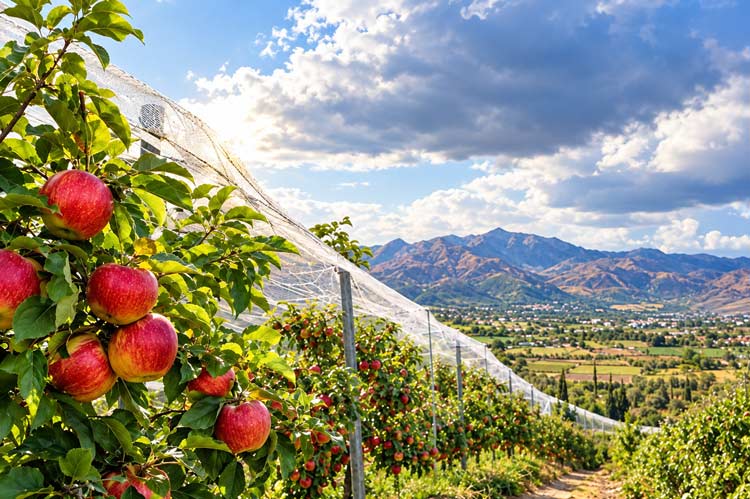
Anti-hail nets remain one of the most tangible forms of physical protection.
Their principle is simple: prevent hailstones from directly striking fruit and trees.
But the real policy question is not whether nets can protect orchards. It is:
How can they be deployed at sufficient scale, in the right locations and at a cost farmers can afford?
Anti-hail protection has already been introduced in parts of Kasserine. In 2026, a project supported the installation of protective nets over orchards in Sbikha and Foussana.
The next step should be to move from isolated interventions toward a phased regional protection programme, prioritising the highest-risk areas and the orchards with the greatest economic value.
But Tunisia should not simply copy European models.
Kasserine is not South Tyrol.
Climate, farm size, varieties, financial capacity and market structures are different.
The appropriate approach is therefore adaptation, not imitation.
Research institutions could establish demonstration orchards comparing different net designs, materials and installation systems. Their performance should be measured not only by hail damage avoided, but also by fruit colour, sugar content, size, yield, microclimate and profitability.
The objective is simple:
Find the protection system that delivers the highest economic return under Kasserine’s specific conditions.
The second battle is in the sky
Even the best physical protection cannot eliminate climatic risk.
The next step is better forecasting and early warning.
Kasserine could develop a high-resolution agro-meteorological network covering its principal apple-producing areas. Automatic weather stations could monitor temperature, humidity, pressure, rainfall and wind conditions, while information from Tunisia’s meteorological services could be combined with satellite observations.
But data alone are not enough.
Farmers do not need another generic bulletin saying:
“Thunderstorms are expected locally.”
They need operational information:
Where? When? How serious is the risk? What should I do?
A farmer could receive a simple mobile alert:
«AGRICULTURAL ALERT — HIGH HAIL RISK
Area: Sbiba
Risk window: 17:00–19:00
Alert level: High
Recommended action: Check protective systems and monitor the orchard.»
The difference may appear small.
Economically, it could be enormous.
It transforms weather information into a decision-making tool.
Insurance must become part of the solution
No serious climate-risk strategy can rely exclusively on prevention.
When prevention fails, farmers need financial protection.
Agricultural insurance remains underdeveloped in Tunisia. World Bank analysis indicates that agricultural insurance represented only 0.42% of total insurance premiums in 2021, while catastrophic climate-related losses between 2014 and 2022 were estimated at around TND 345 million.
This creates a structural paradox.
Public authorities often intervene after disasters to support affected farmers. But public compensation is also costly.
The question should therefore be:
Why absorb the full economic cost after the disaster when part of the risk could be transferred beforehand?
One promising option is index-based agricultural insurance.
Instead of requiring an expert to inspect every orchard after a storm, compensation could be linked to predefined meteorological indicators, subject to appropriate calibration and verification.
Such systems could potentially reduce administrative costs and accelerate compensation.
Kasserine could therefore become a pilot territory for a hail-risk insurance product specifically designed for apple growers.
The combination would be much stronger:
Weather stations + risk indicators + insurance + physical protection.
That is risk management rather than disaster compensation.
The forgotten question: what happens to damaged apples?
There is another economic issue that deserves greater attention: the value of fruit that can no longer be sold as premium fresh produce.
A hail-damaged apple may lose its commercial appearance without becoming economically worthless.
Juices, compotes, purées, dried fruit, vinegar and other processed products could absorb part of the downgraded harvest, provided food-safety and quality requirements are met.
This calls for a regional “salvage market” for damaged fruit.
Within 24 to 48 hours after a major storm, production could be classified into three categories:
Grade 1: suitable for the fresh market.
Grade 2: unsuitable for premium fresh sale but suitable for processing.
Grade 3: unsuitable for food processing.
The second category should be rapidly connected with processing facilities.
The objective is not to accept losses.
It is to recover as much economic value as possible from production that can no longer be sold in its original form.
Artificial intelligence: faster damage assessment
Digital technology could provide another layer of protection.
A simple mobile application could allow farmers to photograph damaged fruit and trees immediately after a storm.
Image-analysis systems could provide preliminary estimates of visible damage, affected areas and approximate loss rates.
Such technology should not replace agricultural experts.
It should assist them.
For insurers and public authorities, rapid preliminary damage mapping could accelerate assessment, improve data collection and contribute to better climate-risk models.
Over time, the accumulated data could become an asset in itself.
The more precisely Tunisia understands where, when and how hail damage occurs, the better it can target investment, price risk and design appropriate insurance products.
What should happen now?
Kasserine does not need to wait for a ten-year strategy before acting.
First: create a regional hail-risk task force
It should bring together agricultural authorities, meteorological services, extension officers, producers’ organisations, insurers, researchers and apple growers.
Its first task should be to produce a dynamic risk map identifying the most exposed areas, the value of crops at risk and priority investment needs.
Second: establish a pilot protection zone
Sbiba and Foussana could become a national demonstration area combining:
Anti-hail protection + weather stations + digital alerts + insurance + technical assistance + storage + processing.
The programme should be scientifically evaluated.
After two or three seasons, policymakers should be able to answer a simple question:
How much does a protected orchard lose compared with a comparable unprotected orchard?
That is how agricultural policy moves from assumptions to evidence.
Protecting value, not simply increasing production
Over the next three to five years, Tunisia should broaden its definition of agricultural productivity.
Producing more apples is not enough.
A tonne of additional production creates real economic value only if it can be protected, harvested, stored, processed or sold.
Investment must therefore extend beyond orchards to include anti-hail protection, cold storage, packaging, processing, insurance, climate monitoring, research, digital agriculture and farmer advisory services.
Kasserine has a rare strategic opportunity.
Its strong concentration of apple production makes it possible to test integrated climate-risk management on a meaningful territorial scale.
The region could become more than Tunisia’s apple heartland.
It could become a national laboratory for climate-resilient orchard agriculture.
If successful, the model could later be extended to other fruit crops and other regions exposed to hail, drought, heatwaves and extreme storms.
The objective is not to defeat nature.
It is to reduce our vulnerability to it.
The 2026 season offers a powerful starting point. With production expected to reach around 75,000 tonnes, Kasserine has demonstrated that its productive potential remains considerable.
But increased production without increased protection can also mean increased exposure.
The next ambition must therefore be greater than producing more.
Every additional tonne should progressively become a tonne that is protected, insurable, storable, processable and marketable.
That is the real measure of agricultural resilience.
The battle facing Kasserine is therefore not simply a battle against hailstones falling from the sky.
It is a battle against the vulnerability of an entire agricultural economy.
And the ultimate objective should be clear:
Not merely to grow more apples, but to protect the economic value of every apple Kasserine succeeds in producing.
***
 Dr. Sonia Toumia is a Tunisian researcher and journalist holding a PhD in Islamic Studies from Ez-Zitouna University. She is the Coordinator of the Information and Communication Unit at Gifruit and Editor-in-Chief of “Fruits de Tunisie” magazine.
—
References
– Tunis Afrique Presse (TAP) — 10 September 2026
Kasserine: Apple production expected to reach around 75,000 tonnes.
This source provides the regional agricultural authorities’ figures concerning the 2026 apple harvest and confirms the importance of apple production in Kasserine.
“Tunis Afrique Presse — Kasserine apple production, 2026” https://www.tap.info.tn/en/Portal-Headlines/20570875-kasserine-apple
– Academic study — La grêle en Tunisie : Diagnostic et gestion d’un risque agricole émergent
This study is used for the historical section concerning the major hailstorms of 2 and 10 May 2002. It documents damage affecting approximately 2,515 hectares of apple orchards in Kasserine, including severe damage in Sbiba, and a significant decline in regional apple production following the storms. The study draws on data from the Kasserine Regional Commissariat for Agricultural Development (CRDA) and contemporary press archives.
“Academic study — Hail risk and arboriculture in Tunisia”
– World Bank — Tunisia Disaster Risk Finance Framework
This report supports the figures concerning agricultural insurance and climate-related disaster losses in Tunisia. It reports that agricultural insurance represented approximately 0.42% of total insurance premiums in 2021, while catastrophic climate-related losses during 2014–2022 were estimated at approximately TND 345 million.
“World Bank — Tunisia Disaster Risk Finance Framework”
– World Bank — Agricultural Insurance and Climate Risk in Tunisia
This analysis supports the article’s discussion of index-based agricultural insurance and the development of climate-risk insurance mechanisms in Tunisia. It examines existing gaps in agricultural insurance coverage and the potential role of index-based products in protecting farmers against climate-related risks.
“World Bank — Agricultural Insurance and Climate Risk in Tunisia”