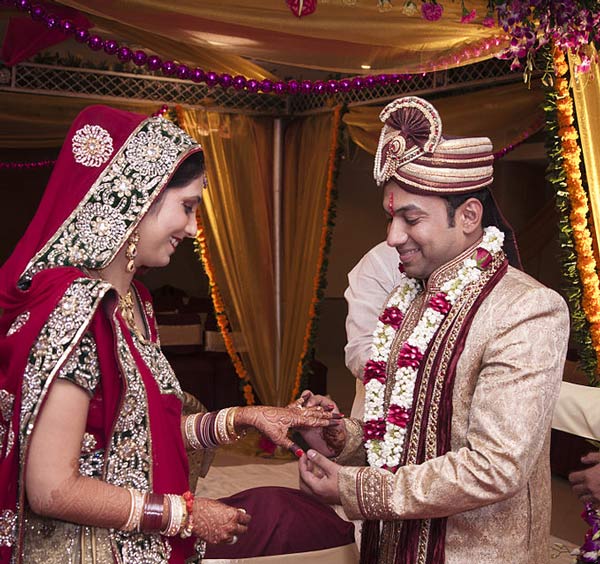
“In many communities the officiant asks the bride whether she accepts the groom on the stated terms, then asks the groom the same, and each answers aloud. That exchange is the marriage.”
By Subhan Ullah
From Lahore to Kuala Lumpur, Muslim weddings look wonderfully different. Yet at the centre of every one sits the same short contract – known as the Nikah. Let’s explore what the Nikah is, what it requires, and how cultures across the Muslim world celebrate around it.
Ask a guest what they remember from a Muslim wedding and you will hear about the colours, the food, the music and the crowd. Few mention the Nikah itself. That is not surprising… the part of the day that actually makes the couple husband and wife is often over in minutes, sometimes in a quiet side room while the party carries on elsewhere.
The Nikah is a contract (aqd) between a man and a woman, and like any contract it has a small number of essential parts. Everything else, from the henna to the processions, is culture. Understanding the difference explains why a Muslim wedding in Dhaka and one in Dubai can feel worlds apart while resting on exactly the same foundation.
The Core: What Makes a Nikah Valid
An offer and an acceptance
At the heart of the Nikah is a clear proposal and a clear acceptance, known in Arabic as ijab and qabul. In many communities the officiant asks the bride whether she accepts the groom on the stated terms, then asks the groom the same, and each answers aloud. That exchange is the marriage.
The bride’s consent
A Nikah is not valid without the woman’s agreement. The Prophet Muhammad said that a previously married woman should not be married without being consulted, and a woman marrying for the first time not without her permission (Sahih al-Bukhari 5136). Forced marriage has no place in Islamic law, whatever some families have done in its name.
A guardian and witnesses
Most Muslim jurists hold that the bride is given in marriage by her guardian, or wali, usually her father. A widely cited narration states, “There is no marriage without the permission of a guardian” (Sunan Abi Dawud 2085). The schools of Islamic law differ on how far the guardian’s role extends, but in practice families are closely involved almost everywhere, whether a match comes through relatives, the local mosque or a Muslim matrimony site. The contract is also concluded before witnesses, traditionally two adult Muslims.
The Mahr
The groom gives the bride a gift called the Mahr. The Quran tells husbands to hand it over “graciously”, as a gift rather than a payment (Quran 4:4). It belongs to the bride alone, not to her parents, and it can be money, gold or anything of value she accepts. It is often mistranslated as “dowry”, but it runs in the opposite direction from the dowry customs found in parts of South Asia.
What is not required
Islamic law does not require a mosque, a wedding dress, rings or a large guest list. An imam usually leads the ceremony; and many ceremonies begin with the short sermon the Prophet taught for important occasions, which praises God and recites verses on mindfulness of Him (Sunan Abi Dawud 2118). The essentials can be completed even in a living room in a quarter of an hour.
One practical point for readers in the West: in some countries, including England and Wales, a Nikah on its own is usually not a legally registered marriage. Many couples therefore hold a civil registration as well, on the same day or separately.
Celebration Is Part of the Tradition
None of this means Muslim weddings are meant to be solemn. The Prophet encouraged couples to share their happiness. He held a wedding meal, the walima, and told a newly married companion, “Give a banquet, even if with one sheep” (Sahih al-Bukhari 5167). When his wife Aishah helped prepare a bride for a man from the Ansar of Madinah, he asked whether they had no entertainment, “as the Ansar like amusement” (Sahih al-Bukhari 5162). He also said that what distinguishes a lawful marriage from an unlawful one is the drum (duff) and the voice of celebration (Sunan an-Nasa’i 3369).
In other words, a wedding should be announced and enjoyed. How that joy is expressed is where cultures take over.
One Contract, Many Celebrations
Pakistan and North India: several days, several events
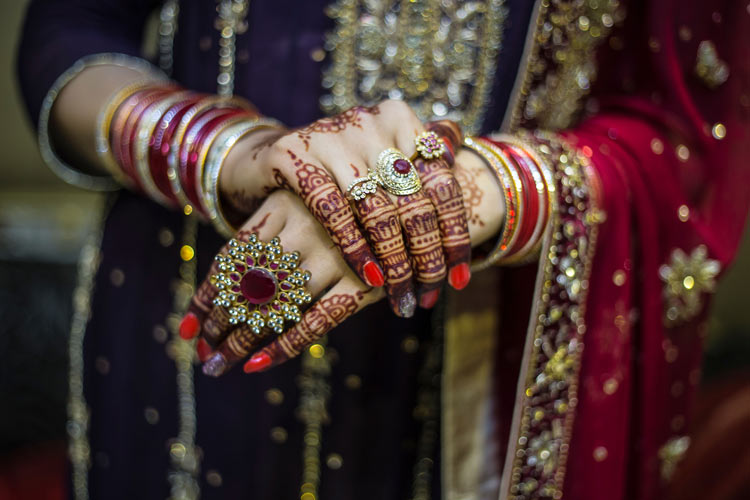
A traditional Pakistani or North Indian Muslim wedding can stretch across a week. The mehndi is a henna night full of music and dancing. On the main day the groom arrives with his family in a procession, the baraat. The Nikah is performed, the bride’s departure from her parents’ home (the rukhsati) is often the most emotional moment of the whole wedding, and the groom’s family later hosts the walima. Of all these, only the Nikah is a religious requirement, and the walima is the one celebration the Sunnah itself recommends.
Bangladesh: the turmeric ceremony
Before a Bangladeshi wedding comes the gaye holud, literally “turmeric on the body”. According to Banglapedia, the national encyclopaedia of Bangladesh, it is held three, five or seven days before the marriage. The bride’s mother, grandmother and older relatives apply the first dabs of turmeric paste on the bride, followed by younger relatives and friends, while women sing traditional songs… (Banglapedia notes the groom has his own ceremony at his family’s home).
This custom is shared by Bengali Muslims and Hindus alike, a reminder of how much wedding culture belongs to a region rather than a religion.
The Gulf: the bridal procession
In the United Arab Emirates, the al zaffa marks the bride’s move from her family home to her marital home. Abu Dhabi Culture, which lists it among the UAE’s UNESCO-inscribed heritage, describes processions accompanied by drums and chanting: one in the mid-morning after the wedding, led by female relatives and neighbours; and another straight after the wedding-night celebration. Across the wider Arab world, the zaffa has grown into a grand entrance with drummers and dancers.
Türkiye: the henna night
Turkish brides celebrate the kına gecesi, or henna night, a day or two before the wedding. According to GoTürkiye, the country’s official tourism site, the bride keeps her hand closed until her future mother-in-law places a gold coin in her palm, and only then is the henna applied to the bride’s palm. Folk songs are sung, and the bride is expected to shed a few tears, because she is leaving her family’s home.
Malaysia: the contract, then the throne
Malay weddings separate the religious and the ceremonial very clearly. The akad nikah, the marriage contract, is usually held the day before the bersanding, according to Malaysia’s National Department for Culture and Arts. At the bersanding, the couple sits side by side on a decorated dais, the pelamin, like royalty for the day, while relatives bless them with scented rice and water in the tepung tawar ritual.
Northern Nigeria: a short contract and a long party
Among the Hausa-Fulani of northern Nigeria, the contract ceremony, often called the fatiha, can be remarkably brief. A study cited by the Immigration and Refugee Board of Canada describes it as usually an all-male affair lasting about ten to fifteen minutes, after which the celebrations become a women’s affair. It is perhaps the clearest example of the pattern seen everywhere: a short contract at the centre, and a long, joyful celebration around it.
If You Are Invited to a Nikah
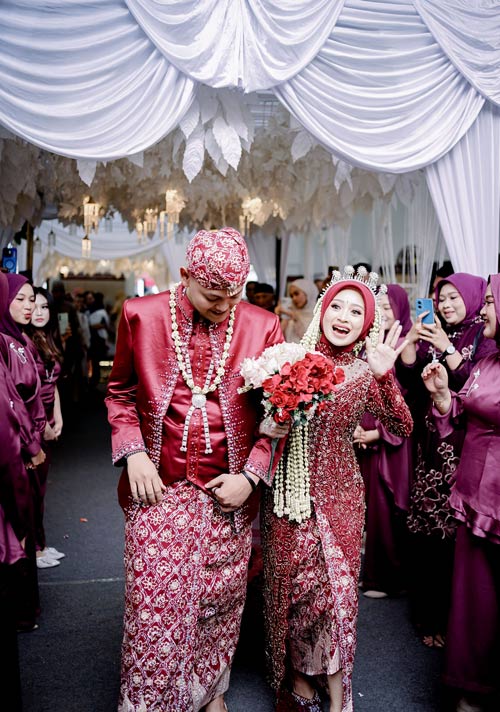
For guests attending their first Muslim wedding, a few simple points help:
- Dress modestly. Covering arms and legs is respectful, and women may want to bring a scarf if the Nikah takes place in a mosque.
- Expect some separation. Some families seat men and women separately, others do not. Follow your hosts’ lead.
- Do not miss the contract. It may be short, early and easy to overlook. Ask when it is, because it is the moment that matters most to the couple.
- Know what to say. “Mubarak” (congratulations) is welcome everywhere. You may also hear the blessing the Prophet used to congratulate a newly married man: “May God bless you, shower His blessings upon you, and bring you both together in goodness” (Sunan Abi Dawud 2130).
- No alcohol. Food will be halal and drinks soft, however lavish the reception.
The Same Foundation Everywhere
It is easy to mistake the outward celebration for the marriage itself, and many families spend accordingly. But the Nikah is remarkably simple: two people who consent, a gift to the bride, a guardian and witnesses, and words of acceptance spoken aloud. Turmeric in Dhaka, drums in Abu Dhabi, a golden dais in Kuala Lumpur and a ten-minute gathering in Kano are all ways of celebrating the same promise. The colour belongs to culture. The contract belongs to every Muslim couple, wherever they marry.
Subhan Ullah works in digital PR at Pure Matrimony, a UK marriage platform for practising Muslims, and writes about Muslim marriage and family life.