
New Amen Clinics research finds several distinct brain-function patterns in postpartum depression, differing significantly from those seen in major depression.

By Amen Clinics, Inc.
COSTA MESA, Calif., Oct. 2, 2026
The high-profile Lindsay Clancy case has brought renewed attention to the serious mental health challenges women can face after giving birth.
Clancy, a Massachusetts mother who killed her three young children in 2023, had sought psychiatric help and received numerous medications in the months before the tragedy. Her defense argued that she was experiencing postpartum psychosis and had not received appropriate treatment, while prosecution experts disputed this claim.
It has sparked a critical conversation about postpartum mental health care and how biology factors into psychiatric diagnosis and treatment. For example, are there functional brain differences between postpartum depression vs depression?
Now, new research from Dr. Daniel Amen and colleagues, currently in preparation for publication, is using brain SPECT imaging to more fully understand the underlying brain function patterns associated with postpartum depression (PPD). Using SPECT, the researchers examined whether women diagnosed with PPD share a common brain pattern and whether their patterns differ from those seen in depression more broadly.
Dr. Amen and colleagues reviewed brain SPECT scans from 58 women with postpartum depression and compared them with scans from 26,077 people with major depression. The scans were grouped into six brain-function patterns, including hyperfrontal/anterior cingulate cortex (ACC), limbic, hypofrontal, toxic/diffuse low perfusion, brain trauma/acquired injury, and mixed patterns.
Key Study Statistics
- Nearly 40% of women with PPD showed a hyperfrontal/ACC pattern, compared with 19.4% of those with major depression.
- Limbic patterns were also about twice as common: 24.1% in PPD versus 12% in major depression.
- Hypofrontal patterns appeared in 15.5% of PPD patients versus 6.8% in major depression.
One of the most striking differences involved the brain trauma/acquired injury pattern: it appeared in 25.3% of the major depression group but just 1.7% of the postpartum depression group.
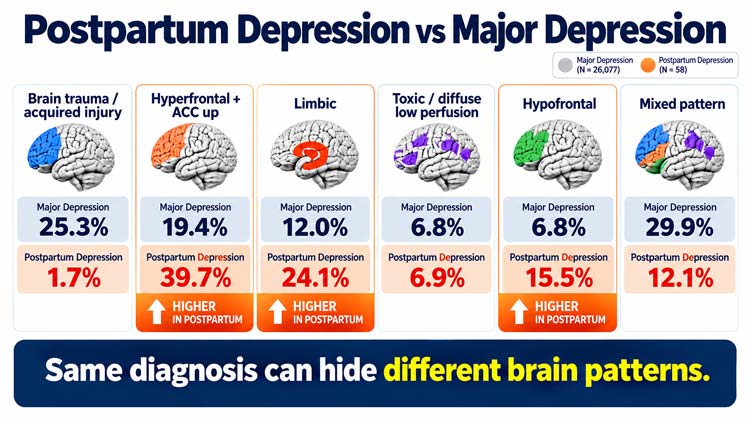
These new research findings from Amen Clinics reinforce an important point: The same psychiatric diagnosis can encompass different patterns of brain function. Understanding those differences may help explain why women with similar symptoms can respond differently to treatment and why a more individualized approach to care may be beneficial.
The new Amen Clinics research adds to a growing body of evidence suggesting that psychiatric diagnoses based on symptoms alone may not tell the whole story. Women with postpartum depression in the study showed several distinct patterns of brain function, and those patterns differed significantly from those seen in the much larger major depression group.
At Amen Clinics, brain SPECT imaging is not used in isolation to diagnose postpartum depression or determine treatment. It is one component of a comprehensive evaluation designed to provide clinicians with more information about the individual patient.
The emerging postpartum depression research suggests why that additional information may matter: The same symptoms and diagnostic labels can be associated with different patterns in the brain, and understanding those differences may ultimately help support more individualized care.
Read the full Amen Clinics article on postpartum depression vs. depression.
About Amen Clinics
For decades, Amen Clinics has used brain SPECT imaging as part of a comprehensive evaluation of mental health conditions.
Based on a database of nearly 300,000 SPECT scans, Amen Clinics clinicians have identified certain brain patterns, or brain dysfunction, associated with different mental health conditions. www.amenclinics.com


